
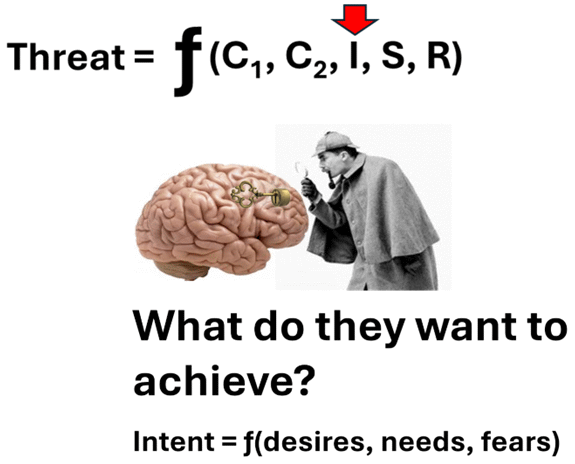
Threat Part 6: Intent- Needs, Desires, and Fears
What the threat wants to achieve is a function of desires, needs, and fears:
Intent = ƒ(desires, needs, fears)
There is a theory that if people and nations just understood each other and could clearly see their motive, needs, and fears, there would be little or no war. Even Star Trek had an episode or two along these lines. I am not at all sure that logic would hold for Hitler, Staling, Mao, and others behind devastating wars and internal mass killings to gain power and control. But it could prevent some wars, possibly even one as catastrophic as WWI. Trust, however, is the key, and it is in very short supply in international relations. Even long-term allies have trust issues. Look at Denmark now saying the US is a threat. Too often, an organization or state’s needs and desires trigger another’s fears, leading to a vicious cycle.
Look at the Germanic notion of Lebensraum in WWII as an example. Germany expressed a need for “living space” and invaded the east to take it from what they considered the inferior Slavic peoples.
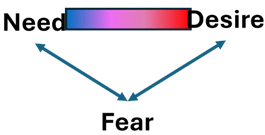 We may sometimes find it difficult to tell what is truly a need versus a desire. Askdifference says a need is “A requirement necessary for survival or to achieve a goal.” While a desire is “A strong feeling of wanting something”, but it can be “postponed or ignored without immediate harm.” Was the Japanese drive for metals and other resources a legitimate cause for war in WWII, especially when the US cut off the flow of scrap metal? Did their actions cause the West to deprive them of resources? The wars the Robber Barons waged in the Gilded Age arise out of desire or need? Perhaps the difference between need and desire is a continuum that is sometimes difficult to separate. Perhaps the difference is in the eye of the beholder. Does Maslow’s Hierarchy of Needs have a place in threat assessment?
So where is China’s threat to invade Taiwan on this spectrum? On the surface, the looming conflict appears to be more on the desire side of the equation. To an outsider looking in, with limited knowledge of the internal dynamics within China, it appears the potential invasion is more about the desire to expand and control all territory they see as Chinese.
But what if there are internal stressors in China that drive the need to invade Taiwan? Are these needs or desires? During the Cold War, the West was unaware of or ignored the internal stresses within the Soviet Union that broke it apart. The same can be said for Japan, Inc. in the 1990s. Japan looked unstoppable, but there were internal stressors that stopped it in its tracks. Today, few born in this century can envision the Japan of the 1990s.
Can stressors induce fear and even paranoia that provoke a threat to act?
The same fear-desire-need function states exhibit may be said of Amazon and other powerful global companies. Why do they need to expand and put other companies out of business? Is it a need or a desire? At the base level, it is to develop higher returns for stockholders. But does a drive to lower prices and provide better goods and services factor in? Is it the desire to be the biggest, to dominate the market, and continue to grow? Of do the the key executives have a more corporatist objective in mind that growth and market domination facilitate?
If you run a bricks and mortar store, is Amazon a threat, an opportunity or a bit of both?
If you do not understand the internal dynamics of a threat, you may mis-categorize the threat and potentially provoke a threat action. That is why the socio-cultural/political dimension to the threat is so critical. Does China have internal stressors similar to the Soviet Union and Japan that will work to undermine the government and/or political coherence? Is the threat to Taiwan in attempt to alleviate these stresses?





One Comment
Pingback: