
Threat 8a: Because That is where the money Is
Willie Sutton is most often credited with replying, “Because that is where the money is” when asked why robbed banks. Sutton denies he said that. Quote Investigator attributes the statement to Paul Perritt, who was 26 years old when he confessed to a series of robberies in 1923. In 1900, a bank president, speaking of taxation, said, “Of course, banks are always a shining mark when the arrows of assessment are flying. The assessors take the famous advice which the father gave his son: “If you want money, go where money is.” .
Part 8 of this series finished with a corporate example of risk and regime change (corporate takeover).The post stated that a corporate takeover is essentially a regime change. I received a little legitimate questioning of that statement. This post addresses those questions and concerns.
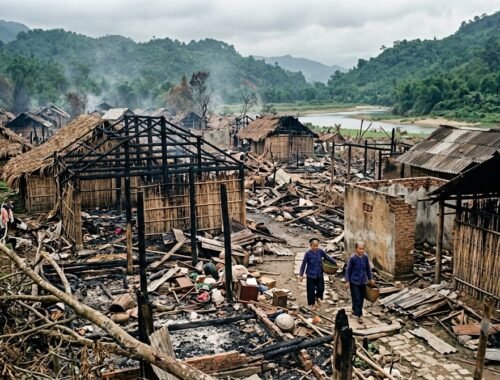
For a moment, imagine yourself running a local, family-owned hardware store. Your family has owned and operated for nearly fifty years, and it is an anchor for the community. Your store has stood with the community through thick and thin, providing jobs, sponsoring local sports teams, helping in emergencies and in other small ways. Then Hechingers comes into the area and puts you out of business. Your workers are laid off, the kids’ sports teams lose a sponsor, and the community loses an anchor. Now consider yourself an executive with Hechingers, watching as Home Depot and Lowe’s move into your market space and one-by-one your stores close and you are facing going out of business. Then Hechingers closes and more people are out of work. That is corporate regime change.
Perhaps no one died, but families were put in extreme financial hardship and communities watched their local stores—from groceries to movie theaters to bookstores to hardware and other stores — disappear and a sense of community starts to disappear.
Why do large corporations do this? In one sense, it comes from an ancient drive Thucydides expressed in the Melian Dialog in the History of the Pelopennesian War: “The strong do what they can and the weak suffer what they must.”
The plethora of business books that quote Sun Tzu (The Art of War), Clausewitz (On War), and Musashi (Book of Five Rings), and to a lesser extent Jomini (The Art of War) echo this concept. There may be far less difference that a state empire and a commercial empire than many of us think. The British East India Company and the Hudson Bay Company are two prime examples.
Why?
In one sense, business programs flog growth, and I have seen statements such as “you are either growing or dying.” We have a definite bias towards growth in business. But I think it is more than that.
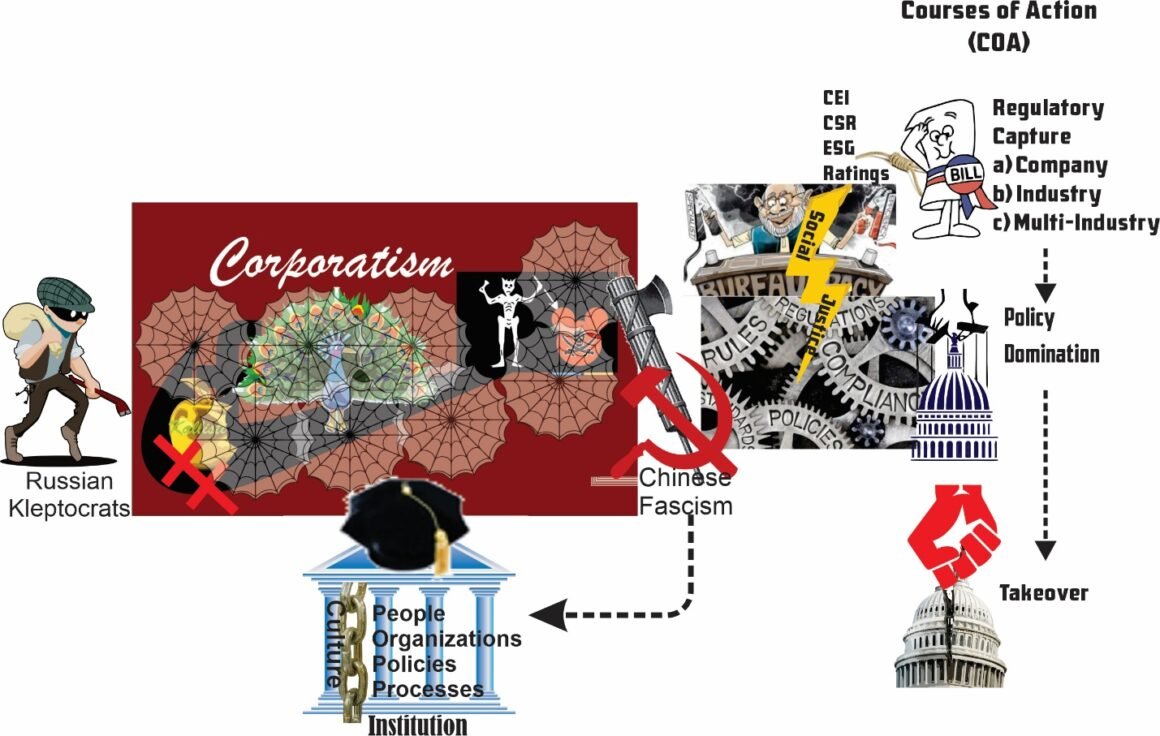
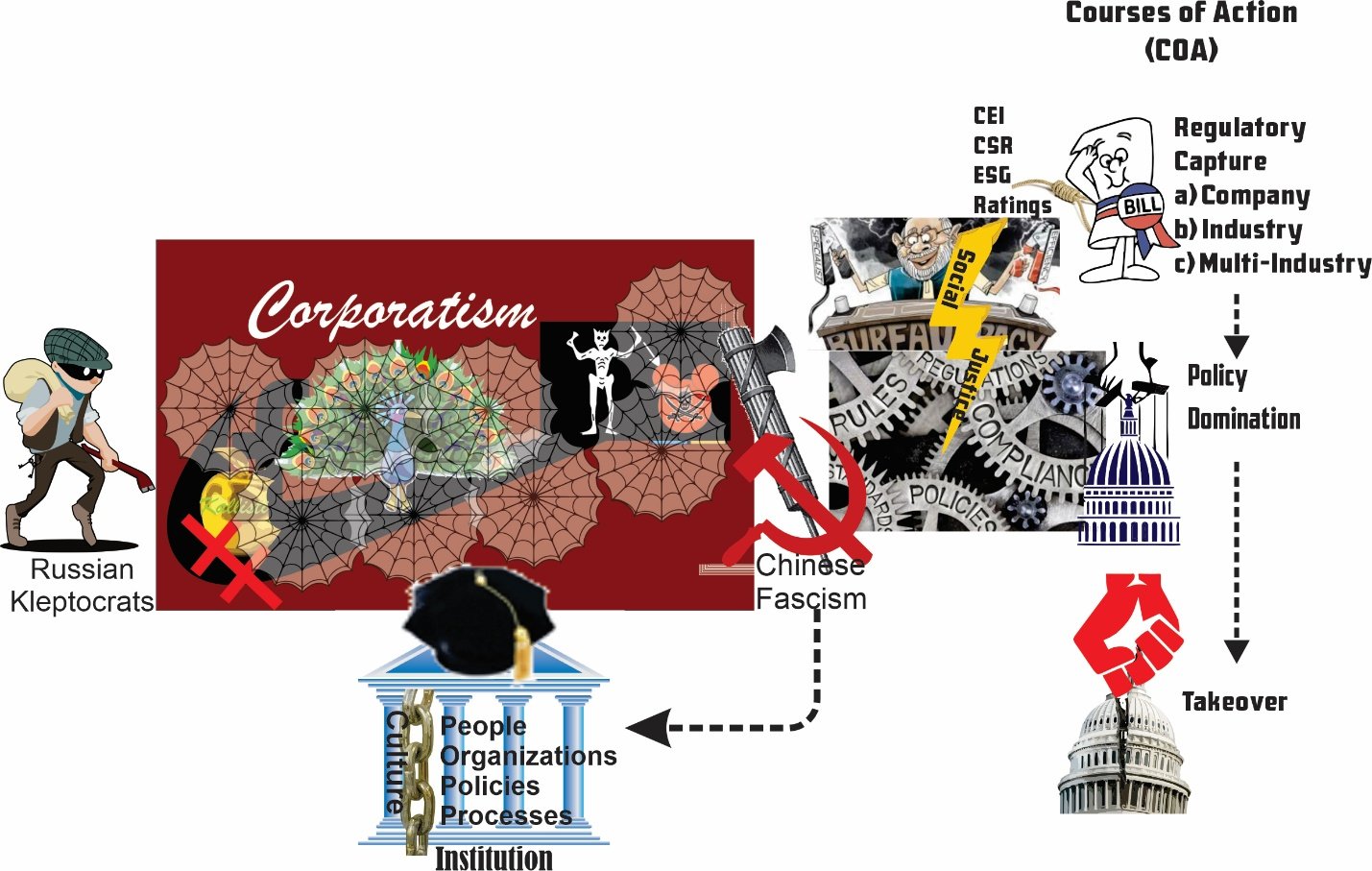
I have written extensively on corporatism and fascism, such as Part 6—A Riddle Wrapped in a Mystery Wrapped Inside an Enigma. When the government is on top, it is fascism. When the corporations are on top or more or less co-equal, it is corporatism. China is a good example of a fascist state. It uses its corporations as arms of the state for espionage and other activities. The US may be moving toward an example of corporatism.
 By why do corporations and CEOs do this? One simple explanation is money. Larger corporations can generate larger returns for shareholders and larger salaries for CEOs. But is it really about money? No, I do not think so. It is more about power. Money is a means to power.
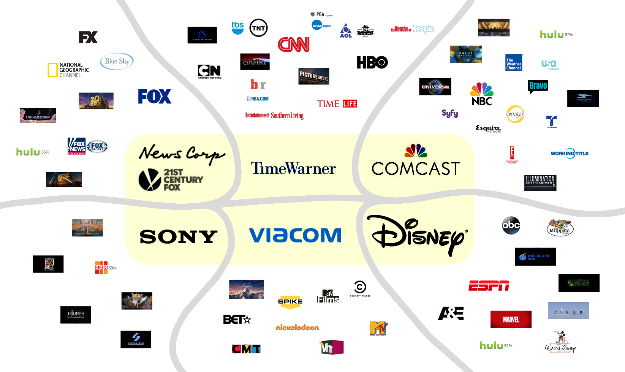
Being a billionaire carries clout and influence. It also allows the billionaire to buy access and power. The large corporations can control industries and services, such as the media, finance, and defense. For example, goodizen says six companies own 90% of the US media. Now, I suspect that claim needs some more rigorous analysis, but if you look at the media chart above from goodizen, we can see the logic behind the claim. There is actually a term for this control: media imperialism. The paper, Media Imperialism on Sage, states: “What does it mean to talk of “media imperialism?” The expression implies that certain forms of imperialism are directly related to the media in some way.” I think this is key. Just as the British East India Company was an arm of the British Empire, the media is an of another empire. But what?
 There is a clear trend towards globalism. But who is driving it? One could say the United Nations, but that organization is fairly inept. To answer that question, one has to consider which institution already has a global footprint? Multinational Corporations (MNC).
MNC already have strong global footprints and enormous control of key industries such as energy, media, pharmaceuticals, and defense production. They shape elections and influence politicians through corporate PACs and billionaire political donations. Corporatism Part 1: Overview summarizes this issue. A novel I wrote back in the distant 1990s, Unleashing the Wolf, discussed this idea of corporate control. Many of the events in this novel are unfolding today.
In theory, western governments regulate and control these companies, but decades of research into regulatory capture, seems to at least question the relationship between government and corporations. See, for example, Regulatory Capture and other Bureaucratic Problems.
So when a small, family-owned business dies, ask yourself, why?


One Comment
Pingback: