
Memory and Thought: The Basis of Cognition
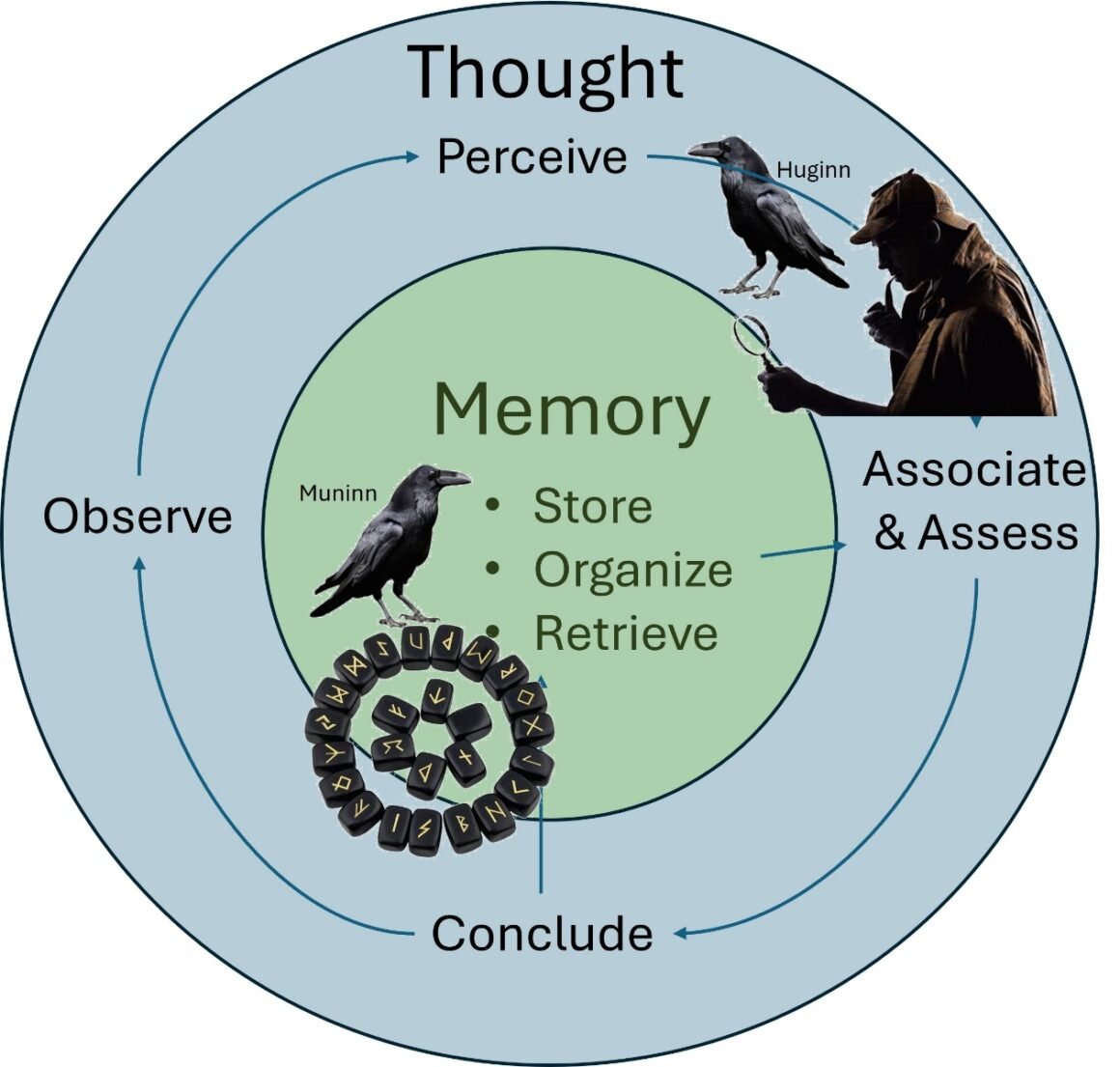
In Norse mythology, Odin had two ravens, Huginn and Muninn, who flew around the world bringing him information. Their names mean Thought and Memory. In mythology, Odin also hung himself on the World Tree, Yggdrasil, to gain wisdom and knowledge of the runes, the Norse alphabet. Let us set this aside for a moment and turn to another, perhaps more recognized character actor, Sherlock Holmes.
One of the most memorable phrases attributed to Holmes is “Elementary, my dear Watson.” Arthur Conan Doyle never penned this line. It came out in the robust secondary market of movies and spin-off stories, just as the deerstalker cap did. However it came about, it is very Holmesian and is now an integral part of the Holmes character, proving even characters can grow.
In the books, movies, and TV shows, Holmes had an ability to observe, perceive, associate, and quickly assess and then make conclusions based on observations and retrieved data. It is not, however, specifically unique to Holmes. It is integral to every person and increasingly to AI. What is unique is Holmes’ ability to rapidly integrate them and keep all the facts needed in active memory. That is how he could look at hands, clothing, lint, cat hair, and other items to make inferences about the person as he related his perceptions to retrieved data.
The combination of observation and perception is critical. One can observe something but not perceive it or its details. Perception brings an observation into consciousness for association and analysis. Biases or a lack of ability to associate observations with experience (memory) can impair perception. The stronger our biases, the more they can impair our perception and the analysis of what the perceived observation means. Biases and lack of organization, or limited data are filters that impede perception.
Also, even if what we perceive makes it through bias filters, if the conditions in the environment differ from how we built our internal memory base, we could reach inappropriate conclusions. Therefore, the two key questions we need to ask ourselves are:
- How do my biases affect what I see and perceive?
- Am I in the relevant range of my memory base, or is something different going on that I need to factor into a more deliberate analysis?
The second question about using System 1 or System 2 thinking (see https://greenmanhouse.net/critical-thinking-decisions-and-system1-system2-thinking/). System1 thinking works when we are in the relevant range of the memory base and provides for quick decision-making using heuristics. System 1thinking works best when we are outside the relevant range and need a more deliberate approach to decision-making.
Imagine ripping Sherlock Holmes out of the pages of his 19th-century setting and inserting him into a 21st-century setting. Would he be able to perceive the clues and make sense of them, when some did not exist in his timeframe and those that did may have had different contexts associated with them? It may not be elementary. Heck, he may go to jail for using cocaine, which was not illegal when Doyle developed the character. We could say the same thing if we moved a line manager from a heavy manufacturing company to a service company. Good ones will adapt, but in the heat of the moment may not perceive the critical items for a decision until they adjust their internal memory models.
The other process is memory, which involves storing facts and information in some form of organized lattice, and the ability to retrieve the information for association with observations and analysis. Cicero and other Roman and Greek orators used various memory aids to deliver their speeches and poetry. A common one is the memory palace that Giordano Bruno later used and discussed before the Catholic Church executed him for heresy.
This is also where the second aspect of Odin’s mythos comes into play. Part of the reason Odin hung on Yggdrasil for 9 days was to gain the knowledge of Runes, the Nordic alphabet. This gave Odin the ability to record what he learned from his two ravens and other sources.
If a system cannot record and organize data effectively, it will be useless. Learning science provides quite a few techniques, including the memory palace, for humans. Data science provides tools for storage and organization in various systems. My book, Thrive in the Age of Knowledge, discusses data organization and management.
But if a human is in the decision loop, he or she still needs to refer back to internal memory and analysis to make the decision. As long as people make decisions, the memory-thought dynamic will be important.



One Comment
Pingback: