

Mindfulness: Critical Thinking and the Eye of the Storm
The interesting secret behind critical thinking is that its components are simple and straightforward. However, the execution of these components together, particularly in challenging situations, is difficult and requires discipline and a focused mind. The events surrounding the need for critical thinking can create a storm that detracts from the ability to do even seemingly simple tasks. We must be like the helmsman who keeps a weather eye out for trouble and steers successfully through the storm. This is essentially the practice of mindfulness. The trick is to create an eye in the storm that allows us to see clearly and engage our critical thinking skills.
So how?
To create and maintain the eye of the storm, we need to deliberately stop and focus the mind and observe the environment, and assess it. Critical thinking is as much about discipline and ingrained habits as it is about the elements of critical thinking. Mindfulness, which the Mayo Clinic defines as “Mindfulness is a state of being mindful and aware of the present moment. It is a type of meditation in which you focus on your thoughts, feelings, body, and surroundings. You do this without judgment. There’s only awareness of the moment as it is.”
In some ways, it is like a person learning to hit a baseball or to ride a bike. At first, it is difficult even to attempt, let alone master the skills required. It takes conscious thought to attune our bodies and minds to these new skills. Then, we learn the basics, and applying the skills becomes second nature, and conscious thought may even get in the way. Then, we need to learn to hit a curveball or ride rough trails. We are back to the skill-learning stage again. The basics are still with us, but we need to add additional dimensions to our skills.
Mindfulness is a tool whose takes every bit of training and discipline as any other tool. Here, the tool clears and focuses the mind to ask the questions raised in Memory and Thought: The Basis of Cognition and Critical Thinking: Logic and Rationality, and the techniques in System 1 and System 2 thinking. See below for a quick recap of the questions.
Mindfulness creates the space and the opportunity to engage in critical thinking processes. These processes are not complex in themselves but can easily be overlooked if we default to a System 1 mode of decision-making and do not examine our perceptual filters and ask the right questions about the situation. We need discipline to delve deeper into the answer and not be tempted to accept surface-level answers that may obscure the truths we need to uncover.
While mindfulness and meditation are similar, they are not the same. In meditation, we often want to clear our minds. In mindfulness, we want to recognize our thoughts and understand them. We can use meditation-like sessions and even some meditation tools to first clear the mind for consideration of the decision or issue we are facing and then ask the questions discussed below and search for answers.
The Mayo Clinic discusses using mindfulness while walking. I’ve often found that to be a great time to reflect on a situation and consider it using critical thinking questions and exploring connections to other issues and decisions.
Like any skill, we must practice mindfulness to develop it into an effective tool for critical thinking. There are two types of practice we need to engage in :
- General mindfulness exercises can be found on the Mayo Clinic mindfulness page and on other mindfulness sites.
- Specific mindfulness/critical thinking exercises. With these, we take a problem, perhaps when we are walking and first clear our mind, then think about a problem and ask ourselves about biases, relevant range, facts and assumptions, and key questions such as who benefits? What does success look like? If we do nothing, what happens?
The more we practice, the more this process becomes natural to us, and the deeper and more nuanced our questions and answers become.
Mindfulness should be an integral part of critical thinking, but is rarely, if ever, mentioned in critical thinking literature. The closest I have seen was when GEN Brown introduced it as part of Cognitive Dominance. Unfortunately, GEN Milley killed off this promising move.
Critical Thinking Questions
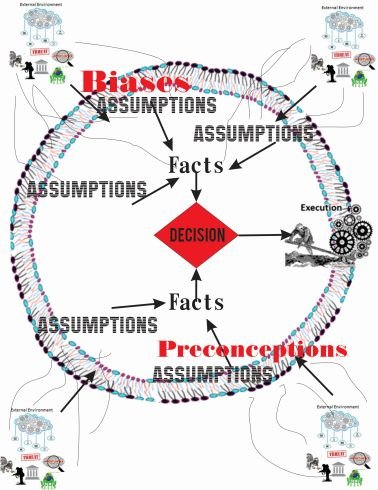 In Memory and Thought, I raised two questions that apply to maintaining the eye of the storm:
- How do my biases affect what I see and perceive?
- Am I in the relevant range of my memory base, or is something different going on that I need to factor into a more deliberate analysis?
These two questions address the perceptual filters that govern what information gets into our thought process and whether we should engage in System 1 or System 2 processes.
 Logic and rationality also bring in assumptions, facts, and emotions, and a series of questions.



One Comment
Pingback: