
Critical Thinking and Symbols
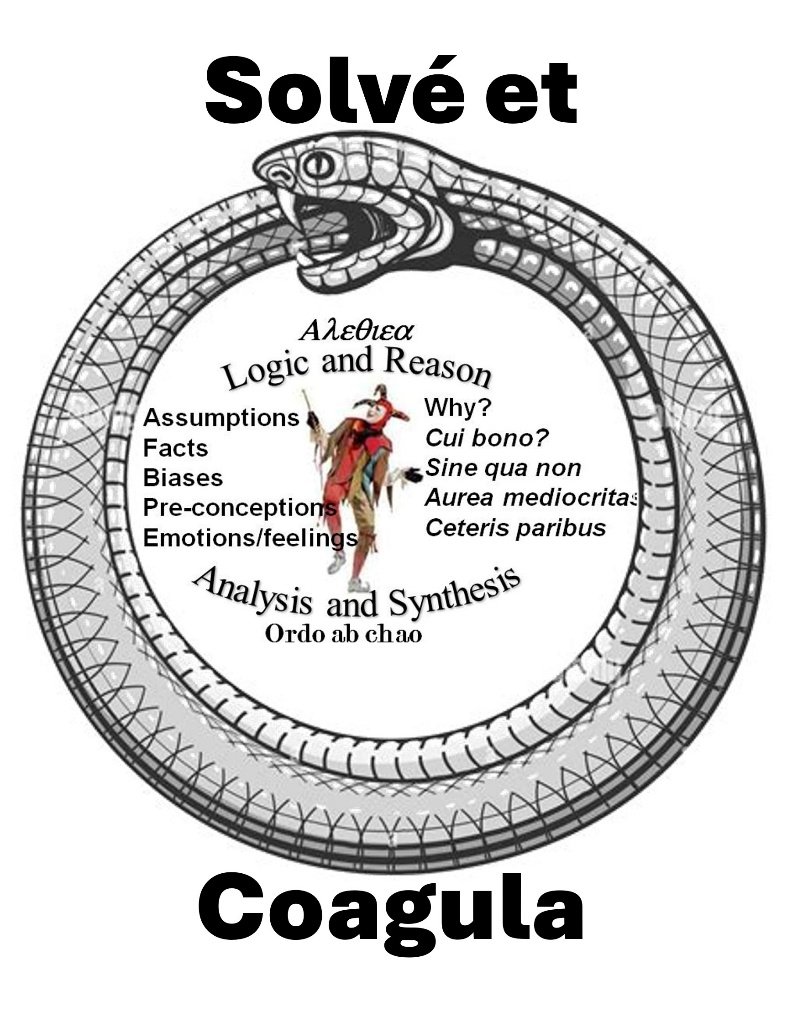
Solvé et Coagula is a term from alchemy that means to break something apart, examine and purify the components and then put it back together. It is the process of “analysis and synthesis”. Now, to most people who have even heard of alchemy, it conjures up images of funny old men in strange robes and hats trying to turn lead into gold. But other sources say turning lead into gold is an allegory for perfecting the mind or spirit. Carl Jung, one of Sigmund Freud’s early followers who later broke with him, is an example. The allegory is like the Masonic rough ashlar and the perfect ashlar.
There is a funny guy in robes; however, in the main graphic. He is not an alchemist, but rather a court jester. The legend of the court jester is that he was the only one in the court who could question the king/earl/duke or whatever office through humor.
The jester, like alchemy in general, is a symbol. In many ways, he is a placeholder for the critical thinking process. The other symbol is the snake swallowing its tail, known as the Ouroboros. This is another symbol associated .with alchemy. According to howstuffworks, the Ouroboros symbolizes nature and the universe in alchemy. Other contexts, and perhaps alchemy as well, associate it with eternity. From a critical thinking perspective, the Ouroboros can represent the perceptual filters addressed in other posts on critical thinking and decision-making. As in alchemy, it can also represent the environment that surrounds the situation or decision.
So why do we care about symbols? Throughout history, humans have created symbols and attached meanings to them. We can see this from the earliest petroglyphs to the memes that permeate social media. Perhaps the major difference between a symbol and a meme is that a symbol encodes information and helps to recall the information, while a meme seeks to change behavior and thought patterns.
In Mindfulness: Critical Thinking and the Eye of the Storm, I discussed using mindfulness as a tool for starting critical thinking, especially during stressful times, to create the eye of the storm to provide space for reflection and analysis. Symbols have traditionally been used to help establish and maintain mindfulness. Realitypathing states:
“At the heart of these practices [mindfulness] lies the concept of symbols—representations that carry meaning beyond their superficial forms. Symbols can play a significant role in enhancing mindfulness experiences, serving as aids for concentration, emotional expression, and personal transformation.”
The Freemasons express this well in their Fellowcraft degree:
“Tools and implements of architecture and symbolic emblems, most expressive are selected by the Fraternity to imprint on the mind wise and serious truths; and thus, through a succession of ages, are transmitted unimpaired the most excellent tenets of our institution.”
There are two key elements in this Masonic lesson. First, symbols can imprint concepts on the mind. Second, during uncertain times, organizations can use symbols that can safeguard truths and secretly transmit information.
Good symbols can establish and maintain the state of mindfulness required to initiate and execute critical thinking.
In our diagram, the jester is the critical thinker or process. Calling up the jester in the mind helps to start the critical thinking process and calm the winds and turbulence of chaos to create the eye of the storm.
The text surrounding him are the tools he employs to engage in critical thinking.
| Tool | Use |
| Bias | Help ensure information passes through the perceptual filters (the Ouroboros) with as little disruption as possible. |
| Facts and Assumptions | This is the solvé part of the process. The jester breaks facts and assumptions apart to study them and better understand them. But the jester also needs to understand the Ouroboros and the relevant ranges. What is a fact in one range may be an assumption in a broader or different range. For example, for most geometry, there are 180° in a triangle. But in non-Euclidean geometry there are 360°. Euclidean is accurate for limited ranges, but for a global analysis it is incorrect. |
| Five Questions | These questions are the “purification” part of the alchemical symbol. By asking these questions, we progressively dig deeper to understand the facts and refine assumptions and turn them into facts. |
| Why? | Perhaps the key question. Why is this happening? |
| Cui bono | Who benefits? This is often akin to “follow the money”. |
| Sine qua non | What is the critical/key element in the situation or problem? |
| aurea mediocritas | What is the safest course of action? Note: this is not necessarily the optimum course of action. |
| ceteris paribus | Look for the dependent and independent variables. Which are most sensitive to change and have the largest impact? |
The last three questions are also part of the “coagula” phase that puts everything back together in a holistic solution/analysis. Sine qua non helps to identify the success criteria. The golden mean of aurea mediocritas, helps us to assess courses of action. Ceteris paribus helps to develop analytical criteria and use them to evaluate courses of action. The symbol uses Latin terms rather than English translations, as the uniqueness of the term itself is a symbol and helps to stimulate the processes and take us out of our normal, everyday mindset.
Let the jester be your friend and traveling companion.


You May Also Like
Re-constructing History, Part 9: Is the Education Institution a Cult?
Part 1: Is Your Culture Like a Railroad or a Multi-modal Transportation System?
