Truth, Justice, and Integrity: Leadership
Thucydides’ account of the Melian Dialog in his history of the Peloponnesian War between Athens and Sparta states the Athenian leaders, “The strong do what they will and the weak endure what they must.” The Melian Dialog essentially makes the case that might makes right. Another way to look at it is the divine right of kings: deity sanctioned power and authority flowed from god(s). Trial by combat was a form of justice based on these two approaches.
This is why Jefferson attacked the King in the Declaration of Independence rather than Parliament. While Parliament held and exercised power, the king was the head of state and could convene and dissolve Parliament. More importantly, the King was a symbol, and traditionally his source was the divine right of kings. That is why Jefferson wrote, “We hold these truths to be self-evident, that all men are created equal, that they are endowed by their Creator with certain unalienable Rights, that among these are Life, Liberty and the pursuit of Happiness. That to secure these rights, Governments are instituted among Men, deriving their just powers from the consent of the governed.” This directly contradicts the divine right of kings and says the source of legitimate power flows from the people—citizens.
Why is this important for leadership and governance? All leadership is rooted in some form of governance. Governance can be formal, like governmental constitutions or charters or organization charters, semi-formal, like processes and procedures, or informal, such as cultures and primitive tribal structures. If leadership is not grounded on legitimate governance, then it is simply raw power, and we are back to the conditions of the Melian Dialog and we have warlords, not leaders. Future essays will cover this in greater detail.
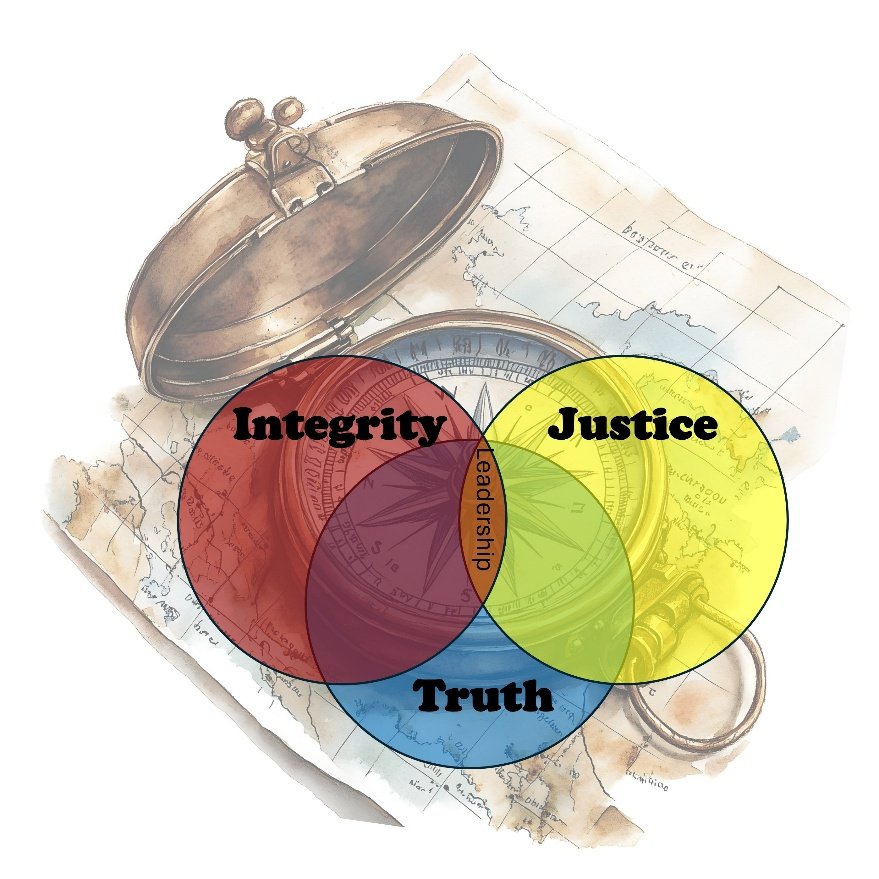
So let us look at the opening figure with the map, compass, and three circles labeled Truth, Justice, and Integrity. Note that the common area is labeled Leadership and is aligned with the North arrow of the compass. True, effective leadership requires truth, justice, and integrity.
Alfred Korzybski said, “the map is not the territory”. “He posited that our perception and understanding of reality are not the reality itself, but rather a model, a map of it. This metaphor is used to convey the difference between our subjective interpretation and the actual objective reality.” Maps are projections of reality and can distort our perceptions if we do not understand how the map is created and the type of projection used. Natural and man-made changes and events can also alter the territory, making maps of these areas outdated and inaccurate. When we accept the map as objectively accurate, it can create biases and problems. This may be especially true if AI changes the territory faster than the map can keep up.
Still, without a map, we are lost. The territory must be explored, and the map updated to reflect our best understanding of reality. The compass helps us explore. But like the map, there are issues we need to keep in mind. The most important issue is that compasses point to magnetic north, and maps use true north. Therefore, maps often show a grid-magnetic angle to help the navigator adjust when moving from the map to the territory. Magnetic north, however, can migrate and change the grid-magnetic angle, making the one printed on the map inaccurate.
Leaders need to understand the territory—their organization and operating environment—and the map—their mental image and rules—and understand their potential biases and how the territory can change.
Now, let us look at the circles of Truth, Justice, and Integrity. Governance only works if people follow the laws, rules, and processes, or the organization has the tools to find non-compliance and the will to enforce them and to sanction violators. Integrity in this case is the willing acceptance and following of the rules or the orderly process to change them. Justice rewards or sanctions behavior. These three concepts are tightly integrated. For example, justice requires truth and integrity.
Truth is fundamental to human understanding and communication. Truth uses facts or reality, and serves as a basis for knowledge, belief, and trust. Philosophers, scientists, and thinkers have debated truth, exploring questions such as whether truth is absolute or relative, and how it can be distinguished from falsehood or deception. In everyday life, truth plays a crucial role in establishing credibility and making informed decisions. It underpins the integrity of information exchanged in personal relationships, journalism, science, and governance. The pursuit of truth often involves rigorous investigation, critical thinking, and a commitment to honesty. Despite its importance, the concept of truth can be complex, as perceptions of reality may vary among individuals and cultures.
Justice is a fundamental concept that underpins the functioning of societies and legal systems worldwide. It refers to the principle of fairness, equality, and moral rightness in the treatment of individuals and the distribution of resources and opportunities. Justice ensures that individuals receive what they are due, whether in terms of rights, responsibilities, or consequences. It is often associated with the idea of impartiality, where decisions are made based on objective criteria rather than personal biases or favoritism. It requires continuous effort and reflection to ensure that it adapts to changing social norms and values, fostering a fair and just environment for all individuals.
Integrity is a fundamental moral principle that emphasizes honesty, consistency, and adherence to ethical standards in all aspects of life. It is the quality of being truthful and transparent, which fosters trust and respect in personal relationships, professional environments, and societal interactions. Leadership knits these concepts together and applies on the territory. In some respects, they are elements of the map since they are concepts. Leaders need to ensure the map reflects the territory and update it as required. They also need to promulgate these concepts throughout their organizations, society, and governance.
Follow-on parts of this society will look at society, organizations, and governance through the lenses of this model.



2 Comments
Mr C E W Fiddes-Payne
Starting with the Melian Dialogue, a negotiation between warring parties in an international conflict, but immediately eliding this with whether the governed should consent as the source of legitimate power is dishonest, and confuses the domestic with the international.
The CCP of the PRC does not govern through consent, so are we to publicly deny its legitimacy, and bomb them as we did the Taliban?
Turning to the conception that “Justice ensures that individuals receive what they are due” – Plato’s from The Republic: distinguishing between “arithmetic” equality (equal shares for all, eg. “one citizen, one vote”) and “geometrical” or proportional equality, which allocates power and resources based on virtue and education, he favours proportional justice, advocating for governance by the morally and intellectually best (or “merit” as Plato’s student Aristotle developed it). Proportional justice allocates power unequally based on merit, while egalitarian justice demands equal shares for all. These differing visions underpin political systems and conflicts throughout history, as Aristotle notes, with disputes over justice often leading to revolutions and upheavals. Ultimately, both thinkers’ works reveal the enduring tension between egalitarian and proportional ideals in political justice.
Pingback: