Santayana, The Opium Wars and Chinese Policy
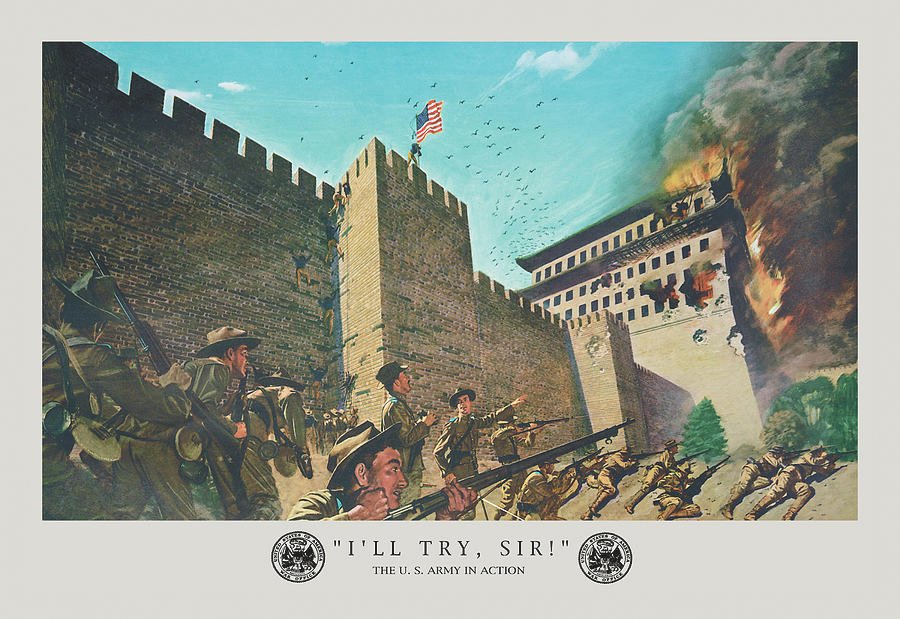
I had a very good high school history program, but had never heard of the Boxer Rebellion or the Opium Wars until Beast Barracks, my first summer at West Point. There, we learned some plebe knowledge about a young soldier that won the Medal of Honor during the Boxer Rebellion and then attended West Point as the only cadet that had the Medal of Honor. I took Diplomatic History and other history courses at West Point and recall little, if anything, about the Opium Wars. The first proper look I had at the Opium Wars was Flashman and the Dragon, one of the Flashman books by George MacDonald Fraser that I found in Afghanistan. While Fraser’s books are humorous, they are well-researched history, and this one was set during the Second Opium War.
There were two Opium Wars and a Boxer Rebellion. The first was Great Britain versus the Qing Dynasty and lasted from 1839 to 1842. The second was Great Britain and France versus the Qing Dynasty and lasted from 1856 to 1860. The objective of both wars was to destabilize the Qing Dynasty, undermine their ability to govern, and essentially make China a dependency. The failed Boxer Rebellion in 1900 to 1901 effectively ended the Qing Dynasty and set the stage for revolution.
As the names suggest, opium was a key part of the strategy. There were two primary objectives with the opium:
- Get the Chinese people addicted to drugs to make them more pliable and less productive.
- Pull wealth out of China to pay for the drugs.
Essentially, the strategy was to enslave the population to drugs at their own expense. The wars started, at least partially, because of the lopsided tea markets. As Lumen Learning notes:
“After the British gained control over the Bengal Presidency, the largest colonial subdivision of British India, in the mid-18th century, the former monopoly on opium production held by the Mughal emperors passed to the East India Company (EIC) under the The East India Company Act, 1793. However, the EIC was £28 million in debt, partly as a result of the insatiable demand for Chinese tea in the UK market. Chinese tea had to be paid for in silver, so silver supplies had to be purchased from continental Europe and Mexico. To redress the imbalance, the EIC began auctions of opium in Calcutta and saw its profits soar from the opium trade. Considering that importation of opium into China had been virtually banned by Chinese law, the EIC established an elaborate trading scheme, partially relying on legal markets and partially leveraging illicit ones. British merchants bought tea in Canton on credit and balanced their debts by selling opium at auction in Calcutta. From there, the opium would reach the Chinese coast hidden aboard British ships and was smuggled into China by native merchants.
In 1797, the EIC further tightened its grip on the opium trade by enforcing direct trade between opium farmers and the British and ending the role of Bengali purchasing agents. British exports of opium to China grew from an estimated 15 long tons in 1730 to 75 long tons in 1773 shipped in over 2,000 chests. The Qing dynasty Jiaqing Emperor issued an imperial decree banning imports of the drug in 1799. Nevertheless, by 1804, the British trade deficit with China turned into a surplus, leading to seven million silver dollars going to India between 1806 and 1809. Meanwhile, Americans entered the opium trade with less expensive but inferior Turkish opium and by 1810 had around 10% of the trade in Canton.”
These wars destabilized the Qing Dynasty and were a significant reason it collapsed. In some ways, this directly led to the Chinese Communist Revolution.
Kevin Eberle, in The Price of Addiction: The Opium War’s Lasting Consequences, wrote:
“China’s feelings of humiliation also influenced the development of the Chinese Communist Party (CCP). The CCP gained support in part by positioning itself as the only force capable of restoring China’s dignity after Western and Japanese aggression. Mao Zedong and subsequent Communist leaders of China framed their struggle as one against foreign imperialism, as well as an internal corrupt elite. The CCP used China’s treatment at the hands of Westerners and Japanese as a justification for radical political and economic policies. The Century of Humiliation continues to play a role in the political rhetoric of modern China, with leaders evoking it to strengthen a sense of nationalism among Chinese people and reject foreign interference.”
What is interesting is that the two Opium Wars are a blueprint on how to use drugs and global trading to destabilize a state and create even more profits. It is probably no accident that the East India Company was at the heart of these wars. It shows the power of corporations and is an early version of corporatism.
This is exactly the strategy China is using in today’s global war with the US. Instead of opium, they were using fentanyl; also, there is plenty of opiates and cocaine to go around as well. The Chinese use Chinese criminal organizations to work with Latin American trafficking organizations to transport and sell the drugs and destabilize American society.
Vanda Felbab-Brown, in a Brookings report, How Chinese criminal networks fuel illicit markets across the Americas, wrote:
“Over the last two decades, Chinese actors have expanded their illicit activities in Latin America and the Caribbean, often taking advantage of the expansion of Chinese legal businesses and trade with the region. The presence of Chinese criminal groups has also grown, sometimes exploiting Chinese diaspora communities in the region. Their activities span a wide spectrum of crimes — from drug trafficking to money laundering, extortion, human smuggling, and illegal fishing, logging, mining, and wildlife trafficking. Chinese drug trafficking networks continue to be the principal suppliers of precursor chemicals for the production of methamphetamine and fentanyl to Mexican cartels that produce both drugs in Mexico. And Chinese money laundering networks have become the go-to money launderers for the Mexican cartels.”
Like the East India Company, they also use their state-owned corporations to steal technology and undermine Western economies.
I suspect the Chinese take some delight in using the techniques the West used to de-establish and impoverish China against the West today. And most Americans do not know the blueprint was developed during the Opium Wars, that most Americans have never heard of, which so badly scarred and shaped the China we engage with today. As Santayana noted, “Those who cannot remember the past are condemned to repeat it.”
If Americans do not understand the current trafficking and drug, and economic conflicts, will we follow the path of the Qing Dynasty?
Will we be in the same position where we did not understand the Iraqi resistance to the British occupation during the League of Nations protectorate and expected the Iraqis to welcome the Americans with bouquets of flowers.
We do a terrible job of teaching and understanding history. And if that doesn’t change, we are doomed to repeat it.


You May Also Like

Educating Citizens versus Sheep, Part 5: The Keystone and Serious Games
The Tragedy of the Commons: Rational Actor