“It became necessary to destroy the town to save it.”
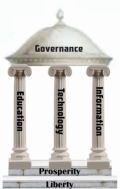
This blog continues the series started with Truth, Justice, and Integrity: Leadership and What Killed Justice? It looks at whether the cure for social problems is worse than the problems. While it focuses on the US political system, the discussions apply to almost any organization.
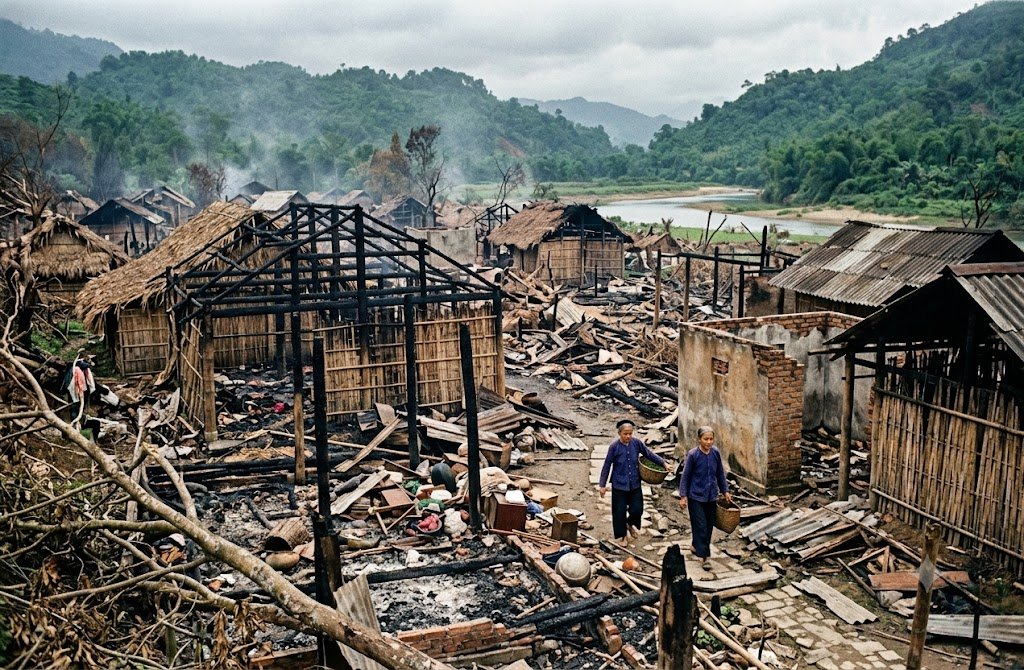
The title of this blog is a quote reported by journalist Peter Arnett during the Battle of Bến Tre, during the Tet Offensive in the Vietnam Conflict. He said a major said it, but did not give a name. Therefore, there is some concern that the quote is not accurate. Regardless of the veracity, it is now a widely quoted meme. While this blog is not about Tet or Vietnam, it sums up what seems to go on in American political thought today, both from a destruction perspective and a transparency and reliability perspective.
I have mulled over this blog entry quite a bit and almost killed the concept a few times. It is a matter of social virtue/justice versus virtue. My concern is that the issues that social justice warriors use to justify their social virtue either existed historically or, sometimes, still do. For historical issues, social justice warriors often say their effects still harm current people. The questions I have are:
- Do they still exist?
- If so, do the social engineering actions cause, exacerbate, or relieve them?
- Or are the people behind the social justice initiatives pushing to enrich themselves and gain power?
One short blog cannot answer these questions. Therefore, this blog will work to frame the issues for later exploration. The key principles in this blog are:
- Are we destroying the engine that creates the prosperity social justice needs?
- Give a man a fish and feed him for a day; teach a man to fish, and you feed him for life
- Two wrongs don’t make a right
This blog entry uses the framework developed in Truth, Justice, and Integrity: Leadership to examine the questions and principles. Key notes on truth, justice, and integrity are listed below for reference.
Truth
In Creating the Monster: The American Bureaucracy, I presented data from the US Census Bureau that the poor in America, especially blacks and single women, are worse off now than they were before the Johnson Administration’s Great Society. As noted in Power Shift, Part 7: The Great Society, the US may have spent over $22 trillion on these programs that have driven people further into poverty.
But that is not all. Many social programs designed to pull people out of poverty undermine the concept of merit and subtly suggest that certain groups cannot compete. This is reflected in declining educational standards and performance. The US ranking is slipping badly, with no end in sight.
We also see the destruction in the fraud that erodes social welfare programs, and the call from many social justice proponents to move away from the Constitution. Look at the wasteland in many of US cities. Seems like a lot of destruction.
So, who do these programs benefit? Large, unaccountable bureaucracies, politicians, and organizations that implement the programs. They do little to benefit those they were designed to help.
But the US has had long-term issues with discrimination and other problems. Some were seemingly resolved, and others continue to linger. We need to truthfully ask: what is the best way to resolve these issues? Instead, we rely on polemics and never truly look at the repercussions and long-term effects of seemingly well-meaning policies.
Justice
The primary vehicle for social justice seems to take something from one group and give it to another. It also seems to require denying civil and social rights to some groups and granting advantages and protections to selected groups. This is not justice. When the legal, political, social, and economic systems discriminated against groups in the past, they created injustice. When they do now with different groups, it is still injustice.
But does it work? When we give something to someone who does not earn it, we diminish the concept of merit and responsibility. But even more lethal for society is that we undermine the concept of self-worth and pride. Anyone who saw Eastern Europe after the fall of Soviet control and before the rise of their own governments saw crops rotting in fields, rusting equipment, idle factories, and empty shelves. We see the same thing in Cuba and Venezuela.
Justice is fundamental to a healthy society. Erode or corrupt justice, and you erode society. We cannot raise one group by pulling down other groups.
Integrity
I sometimes wonder whether integrity has disappeared from governance. Politicians and bureaucrats talk about transparency and integrity, but the windows into political operations are pretty dirty. Then we have constant discussions about corruption, with little apparent action. Virtually all discussion of corruption is focused on social welfare programs, yet the Department of War has not passed a single audit, and there are potentially trillions of dollars missing. If not corruption, it is at least a red flag that procurement systems and internal controls have significant problems.
Another example is the status of Senator Mitch McConnell. The situation surrounding his status is anything but transparent. Alive, dead, a vegetable? There is very little integrity among the political “elites” about his status. This is terrible for the Republic and casts a shadow over Congress. But Congress has been a good job of that with virtually everything.
Then, there is Iran. What are our strategic objectives and endstate? If the administration knows, they are hardly transparent with them. Is the end-state regime change or something else? If it is not regime change, how will the administration ensure that the government of Iran complies with all agreements? They have a bleak track record in that regard. But we should not be surprised. US governments have a poor track record of transparency and integrity in every conflict from Korea onward. And even before, if we include the so-called Banana Wars.
If we are not careful, we will destroy the town but will not save it. We need real policies that address problems in an open and transparent manner, fix the problems they were designed to address, and then sunset. Such policies are scarcer than hen’s teeth because the bureaucracy and politicians, as well as activists and groups that make money on these policies have never met a program they did not want and did not want to continue, regardless of results and effectiveness.
Background
Re-constructing History, Part 8: First, Do No Harm
Power Shift, Part 7: The Great Society
Edwin J. Feulner, in Assessing the ‘Great Society’ in 2014, estimated the US had spent $22 trillion on 80 Great Society programs. That is an enormous amount of money that I suspect has grown substantially in the last seven years as the government adds more programs and recipients to the mix. I’m not sure where Dr. Feulner got his $22 trillion figure, but given the nature of the programs and their longevity, I suspect he is more right than wrong. It represents perhaps the most massive transfer of wealth in history.
Truth, Justice, and Integrity
Truth is fundamental to human understanding and communication. Truth uses facts or reality, and serves as a basis for knowledge, belief, and trust.
Justice is a fundamental concept that underpins the functioning of societies and legal systems worldwide. It refers to the principle of fairness, equality, and moral rightness in the treatment of individuals and the distribution of resources and opportunities. Justice ensures that individuals receive what they are due, whether in terms of rights, responsibilities, or consequences.
Integrity is a fundamental moral principle that emphasizes honesty, consistency, and adherence to ethical standards in all aspects of life. It is the quality of being truthful and transparent, which fosters trust and respect in personal relationships, professional environments, and societal interactions.

What Killed Justice?

You May Also Like

The Warrior Ethos: Part 1 Introduction

Thoughts on Ukraine, Part 5: Post-War Rebuild
