Mindfulness, History, and AI
My wife recently read a book that discusses mindfulness. The gist of the book is that we need to live in the moment and not worry about it, let alone the future. Now, I am not an expert on Buddhism, but I have read some of the core texts translated into English. I think Buddhism, as a philosophy, has much to offer humanity. My impression is that at least part of the motivation behind mindfulness in Buddhism, where I think it springs from, is to escape suffering. Suffering is one of Buddhism’s four truths. Thinking about the past- our mistakes and stupid things we did- can induce suffering. Likewise, worrying about the future can induce suffering. Focusing on the present minimizes suffering.
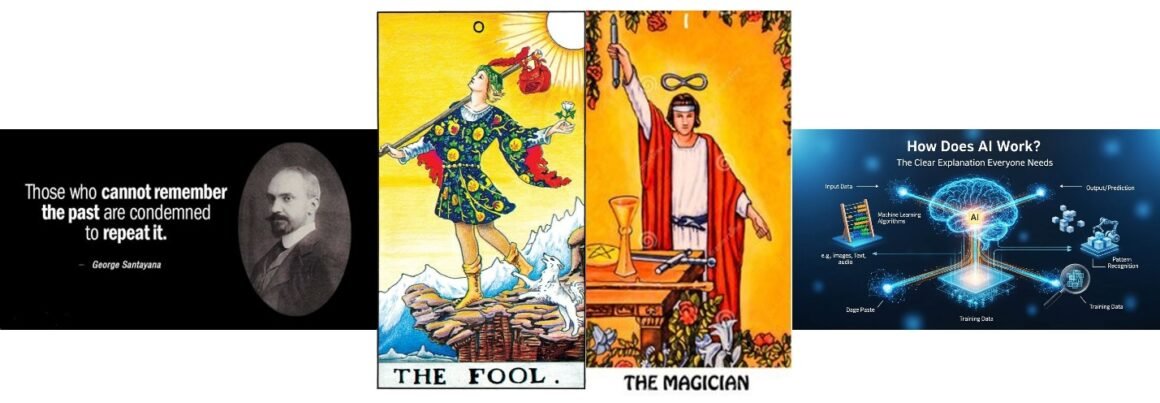
But, as George Santayana wrote, “Those that cannot remember the past are condemned to repeat it.” I suspect that simply living in the present, even if it means reducing suffering from remembering the past, is a recipe for more problems in the future. And failing to consider the future implications of current actions could cause prolonged suffering.
Perhaps a more productive approach to mindfulness is multi-dimensional. We need to focus most of our mindful approach on the present but look back on the past to help us understand how we got here and why. And we need to determine how what is happening today affects tomorrow.
The contrast between a traditional approach to mindfulness, focusing on the present, and a multi-dimensional approach is like the contrast between The Fool and the Magician in tarot. Now, here I am discussing fortune-telling, but meditative practices. In meditative practice, The Fool is the naïve postulant beginning on the learning path. At the same time, The Magician is mature in the path and understands the relationship between “above and below”—in our case, past, present, and future. The traditional Fool card shows a man walking along, oblivious to the cliff before him. He represents Perceval from the Grail mythos (see my blog The Tragedy of the Commons: Wicked Logic [https://greenmanhouse.net/?p=457]). He was the widow’s son, who set forth naively to make his way in the world. Eventually, he matures and passes the tests to find the Grail. This mirrors the meditative tarot approach, where the Fool matures into the Magician.
Multi-dimensional mindfulness can lead to lower suffering than traditional mindfulness. However, I suspect that “traditional” mindfulness is the popular Western approach to a more complex form of mindfulness that approximates multidimensional mindfulness.
So that may be interesting for a meditative approach, but what does it have to do with AI?
I think the “prime directive” of AI should be, “do not let AI become a black box that the user does not understand.” Users need to understand what data the AI tools use and how they use it. They need to evaluate AI results against expectations and explain differences between the results and those expectations. This process is like multi-dimensional mindfulness. The process may include these questions:
- Does the AI process reflect relevant history for the path from history to current conditions?
- Does it list the documents and data consumed in the analysis?
- Does it rank these documents and data according to relevance and importance?
- Is there a map that shows these relationships graphically?
- Is there a way to change the relevance and importance and evaluate the impact of changes?
- Does it accurately reflect present starting conditions?
- What data and documents does it use?
- Are the data and documents ranked by relevance and importance?
- Can we add to or delete from the repository?
- How does the past relate to the present? Can we show it graphically using documents and data from history and present status?
- Does it present the pathway from current conditions to projected future conditions?
- What data and documents does the model use?
- Can we add actions to the model and have the model assess the probability of completion and their impact? Can we turn actions on and off?
- Does the model rank the data and documents for relevance and importance?
- Does the model omit potentially important data and documents?
- Are the data and documents properly vetted?
- Can we conduct sensitivity analysis by adding or omitting data and documents and changing the relevance and importance rankings?
- Is there a map that shows the movement from the present to the future?
- Does the output make sense?
- Does it pass the mindfulness sanity check?
- Can we trace the steps the AI took to decide and the rules or heuristics the AI used?
- Does the output align with expectations and if not, can we trace why?
- AI Considerations
- Do organizational policies and processes identify when and how AI will be used and controlled?
- If the AI has dynamic learning, does it provide an alert to changes based on learning? Does the alert provide actionable information that describes the impact of changes?
- Does the model understand constraints, restraints, and limitations, as well as key agreements and regulations?
Are we The Fool or The Magician?

You May Also Like
Reconstructing History, Part 5: The Education Institution and Creating History
Coexist Part 2: Believers