Was Our Culture Intentionally Disrupted and Broken, Part 3: The Military-Industrial Complex
Abstract: At first blush, the military-industrial complex does not seem to fit with cultural disruption. It does, however, support the significant expansion of the federal government, as shown in the Power Shift series in part 1 and part 6. But the military-industrial complex has grown in both scope and capabilities since President Eisenhower warned us about it. It now includes education, social media, and other IT capabilities. It now has the tools to not only create wars for wealth (see Butler’s War is a Racket) but also to divide and mislead the citizens to further their objectives, which may be essentially the same as the coup Butler reported on during the Franklin Roosevelt administration. President Eisenhower stated we need an “alert and knowledgeable citizenry” to keep everything legitimate. Unfortunately, our education institution does not do this.
At first blush, the military-industrial complex does not seem to fit with cultural disruption. It does, however, support the significant expansion of the federal government as shown in the Power Shift series in part 1 and part 6, the government exploded in size after WWII, driven by the military-industrial complex response to the Cold War and national security and the government implementation of the Great Society.
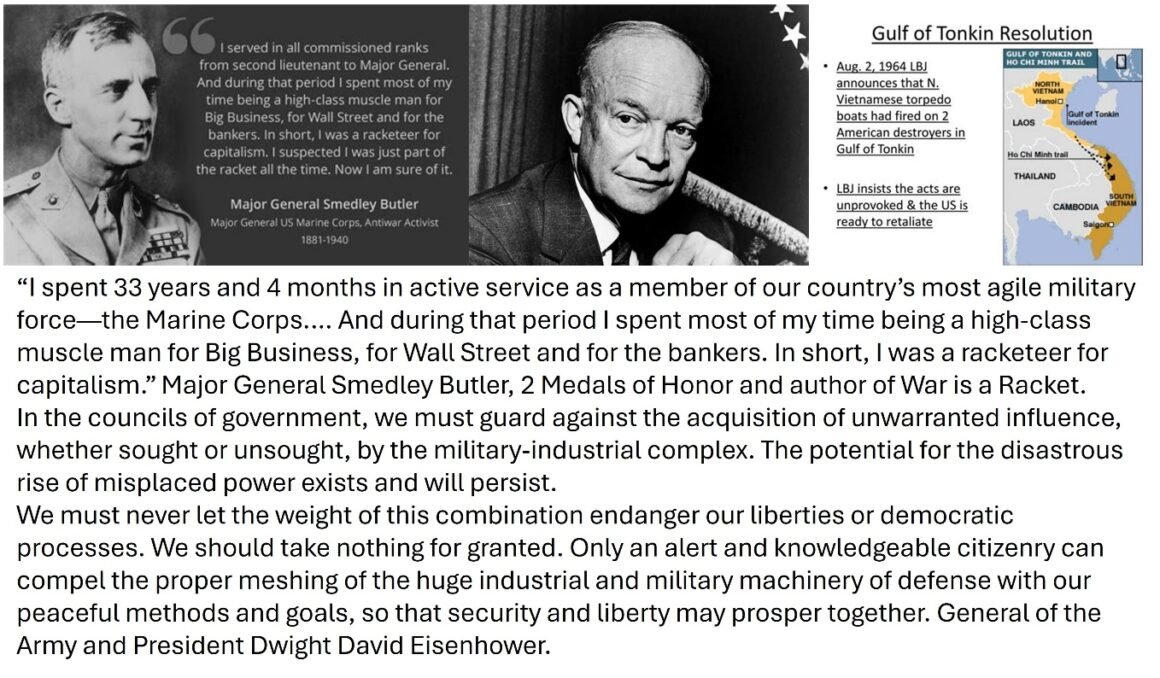
But there is potentially more to the story. Some, like the Gulf of Tonkin Resolution, are factual, and some, like the Kennedy assassination, are fraught with speculation. Then, there is another part of the Major General Butler story that seems to indicate a potential coup attempt during the Franklin Roosevelt administration. The rumors of the Kennedy assassination are that Kennedy wanted to get out of Vietnam, and the military-industrial complex did not, and they conspired to remove Kennedy from office. There are perhaps synergies between this conspiracy theory and the potential coup in Butler’s history.
But for now, let us stay with the Gulf of Tonkin and Vietnam. The Gulf of Tonkin incident and the resolution paved the way to expand the Vietnam intervention. And hundreds of millions and more in billings from the military-industrial complex.
As I quoted in part 2 of this series, “When you have eliminated the impossible, whatever remains, however improbable, must be the truth.”
Let me put a different spin on that quote:
When operatives nest the improbable within the probable, it becomes harder to detect, and as more improbables are woven into the narrative, they become even more difficult to spot and more believable.
A case in point is Tet. By the time Tet happened, the government narrative was already questionable, and some understood the trumped-up Gulf of Tonkin incident. By most measures, Tet was an overwhelming American victory. But the press told a different story and turned Tet into a perceived American disaster and defeat. Their improbable became the accepted truth, even though it was not.
Add to the problems of Vietnam, the reports of the government deliberately exposing troops to nuclear radiation to study its effects and government experiments with LSD.
Regardless of what the military-industrial complex intended, the Vietnam conflict deeply divided the nation and started eroding trust and confidence in the government and the military.
We are facing the same situation today as we move from Afghanistan and Iraq to Iran. Perhaps three things differ from Vietnam:
- The military-industrial complex is perhaps different. I suspect it is more than just weapons and ammunition, the traditional tools of war. The changing nature is changing the make-up of the military-industrial complex. Now, AI, IT, and related companies are part of the military-industrial complex. Traditional software companies such as Microsoft and Oracle are clearly part of it. But so are the growing AI companies and universities. These newer members understand how to manipulate public opinion and nest in with the military’s information operations and PSYOPs capabilities.
- American society is far more heterogeneous than it was during the Vietnam conflict. It will be far easier to create divisions and far more difficult to heal them than during the Vietnam conflict.
- The US is teetering on the verge of corporatism and is potentially more powerful than at any time since the Gilded Age and before President Theodore Roosevelt broke many of the trusts.
I cannot go onto Facebook and, to a lesser extent, LinkedIn without encountering fake news about Iraq. It is incredible. Both sides provide essentially lies that masquerade as truth. And the objective is to confuse, divide, and destroy trust. The new military-industrial complex has the tools and the motivation to do this far more effectively than President Eisenhower ever believed. Even in 1961, he understood the military-industrial complex was evolving: “Our military organization today bears little relation to that known by any of my predecessors in peace time, or indeed by the fighting men of World War II or Korea.”
And as he said in his address, “Only an alert and knowledgeable citizenry can compel the proper meshing of the huge industrial and military machinery of defense with our peaceful methods and goals, so that security and liberty may prosper together.”
But is our education institution developing an “alert and knowledgeable citizenry”? As I have written in several blog series (for example: Using the Education Institution to Create History, Part 1: Introduction, Reconstructing History, Part 5: The Education Institution and Creating History, Educating Sheep Versus Citizens: Part 1, Part 1-Citizen Resiliency in a Republic), the education institution is not only not teaching the required skills, it indoctrinates students into beliefs that are antithetical to the values and norms expressed in our founding documents and is assisted by tech and social media companies.
We will return to Smedley Butler and the potential coup in the next installment.

You May Also Like
Communism’s Dirty Secret (and Capitalism’s and Democracy’s as Well)
Coexist Part 3 The Exploiters and Influencers